Aniimo is a 77 after five days. Palworld is an 85 after three years, and the gap is almost all multiplayer.
Aniimo launched on September 16 on PC, PlayStation 5, Xbox Series X|S, iOS and Android. It is free to play, it comes from Pawprint Studio, and it is an open-world creature-catching game with a continent to explore, creatures to collect and fight with, and a mechanic called Twining that puts the player inside the creature. It arrived with a comparison already attached, because the last creature-catching open world that took over a September was Palworld, and Aniimo looks a lot like it from a distance. Five days in, the audience score from people who have the game in their hands is 77 from 2,630 reactions at very high confidence. Palworld, three years and many patches later, is an 85 from 35,220. This is what the eight points are made of, and what the crowd actually says when it talks about the two games.
We measure what people actually say about a game in public social media conversations and Steam reviews, classified and scored nightly with the sample size and confidence beside every number. Nobody clicks a star. Before release, the same engine produces a hype read from the pre-release conversation, locked on launch day, so the two numbers can be compared. After release, the score is weighted toward people who have played the game over people who have only heard about it.
The hype read: 84, and it never moved
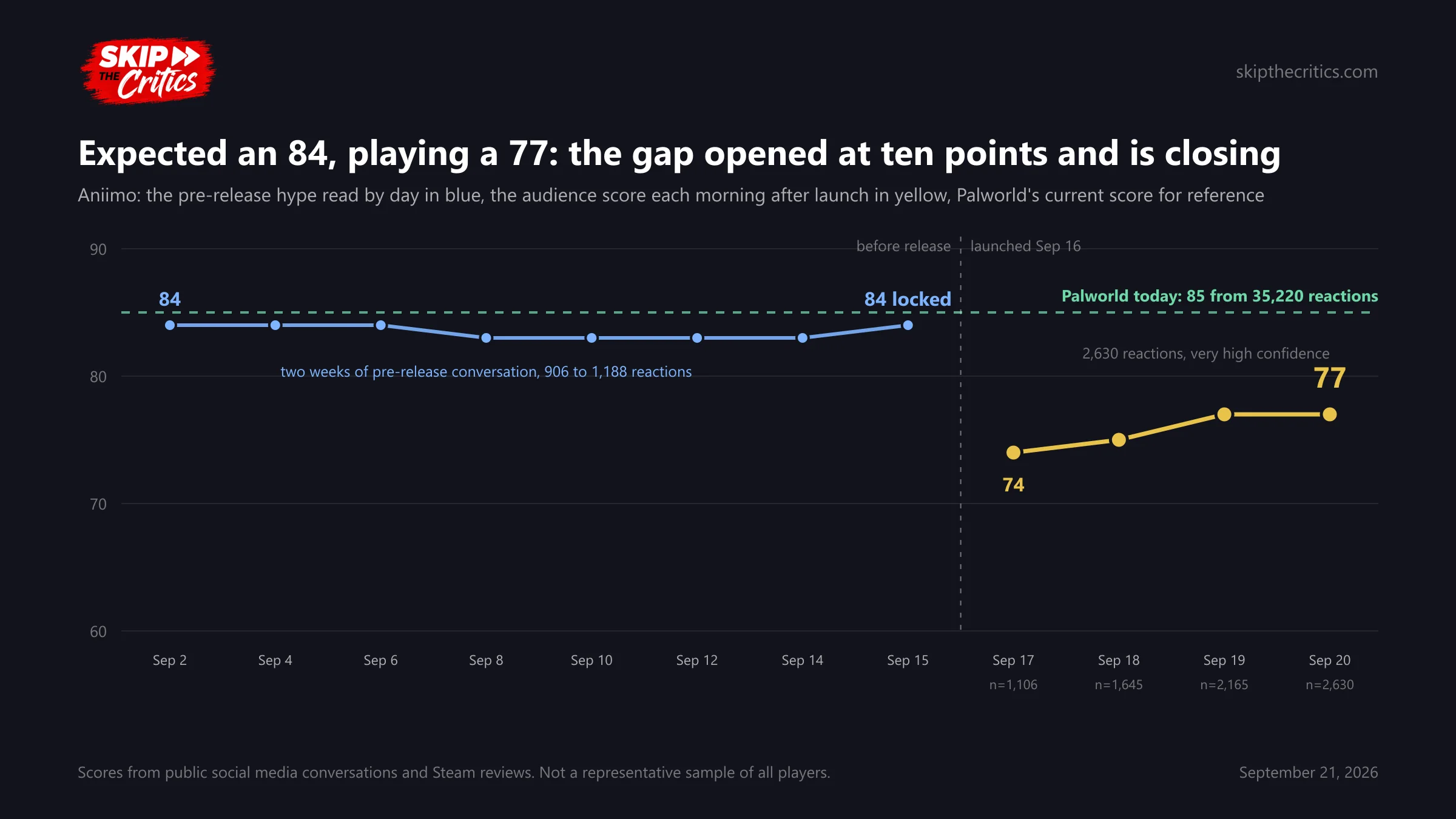
Aniimo entered the program on September 2, two weeks out, with a hype read of 84 from 906 pre-release reactions. It then did something we rarely see: nothing. Every day for two weeks the read was 83 or 84, on a sample that grew to 1,188 by the eve of launch. The pre-release conversation was confident about the gameplay, which scored 89 in the aspect read on 373 mentions, and about the graphics at 84 on 139. It was warm on the story at 85 and the multiplayer at 86, though on thin samples of 27 and 38 mentions, and it had two worries that were not thin at all. Value sat at 54 on 69 mentions, which for a free game means people were worried about how it would make its money. Performance sat at 39 on 27. The developer drew most of the doubt: distrust of the free-to-play model, and of what it would mean on PC and on phones.
Underneath the flat line there was a split that would matter later. Among the 347 pre-release reactions from people who said they had already played it, 84% were positive. Among the 577 who were repeating something they had heard, 41% were. The hype read was steady because the two groups never changed their minds; it was an 84 on the strength of the people who had touched it.
Launch day was the roughest day
September 16 was the busiest day the game has had, 818 reactions, and it was also the sourest: 57% positive, 17% negative. Among people who had played it that day the split was 63% positive and 29% negative. On Steam the launch-day reviews in our sample split exactly even, 86 positive and 86 negative. The first audience score, computed on Thursday morning from 1,106 reactions, was 74.
Then it climbed. Thursday's reactions were 63% positive with players at 72%, and the score moved to 75 from 1,645. Friday's players were 74% positive, Saturday's 75%, and the score reached 77 from 2,165 and held there at 2,630 in the latest pass. The overall split is 74% positive, 7% mixed and 19% negative. The gap under the hype read opened at ten points and has closed to seven.
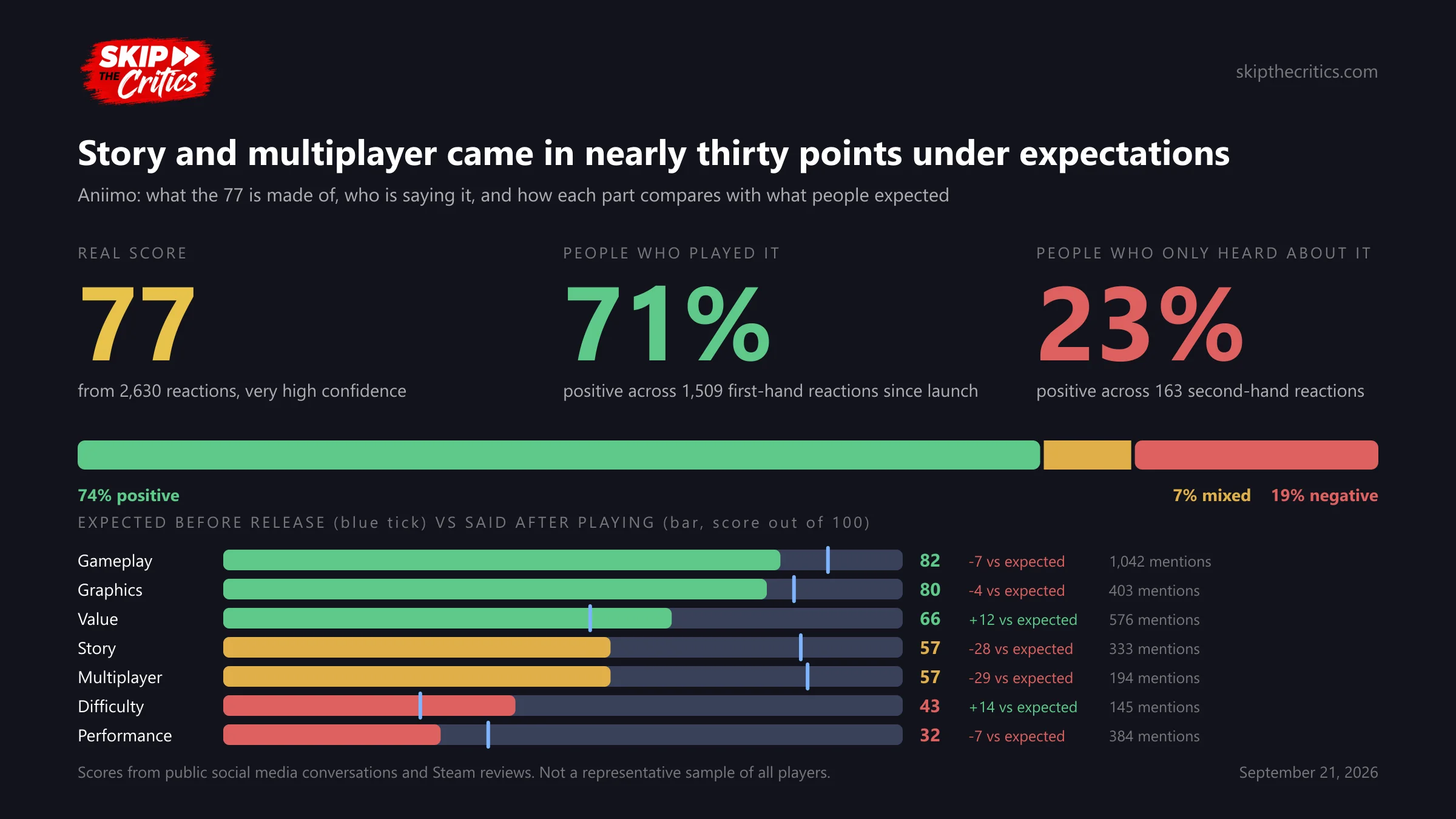
The two groups that were split before launch are further apart after it. Among the 1,509 reactions since launch from people who have played the game, 71% are positive and 21% negative. Among the 163 from people who have only heard about it, 23% are positive and 28% negative. People who watched someone else play, 448 of them, land in between at 64% positive. A free game with a creature-collecting premise draws a lot of opinions from people who have not installed it, and the score is built to listen to the ones who have.
What the 77 is made of
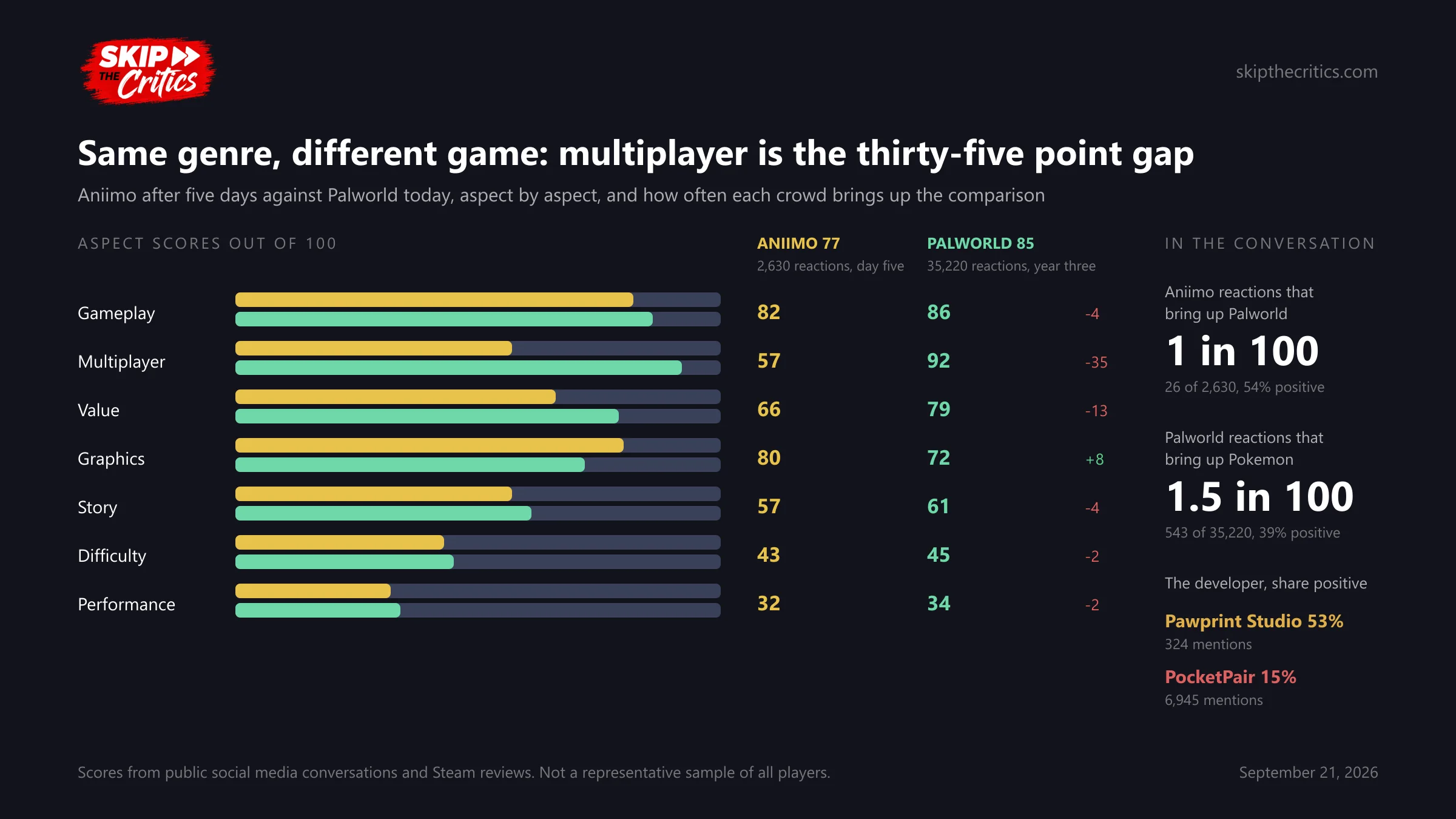
The gameplay is carrying it. Gameplay scores 82 on 1,042 mentions, the most discussed thing about the game by a wide margin, seven points under the pre-release read but still the strongest part. Graphics score 80 on 403. The creatures themselves are the best-liked thing in the conversation: 79% positive across 170 mentions as a feature and 90% across 50 as characters. The continent of Idyll runs 67% positive on 27.
Value went the other way from the worry. It scores 66 on 576 mentions, twelve points above the pre-release read of 54. The free-to-play label itself is 100% positive across 21 mentions, and the battle pass runs 71% positive across 42, which is not a sentence we expected to write. The gacha element is where the doubt landed, 41% positive across 22 mentions. The developer, Pawprint Studio, is discussed in 324 reactions and comes out 53% positive, which for a studio launching a free game with a gacha in it is a better read than the pre-release conversation suggested.
Two things fell far short of expectations. Story scores 57 on 333 mentions, twenty-eight points under the pre-release read. Multiplayer scores 57 on 194 mentions, twenty-nine points under, on a pre-release read that was built from 38 mentions and should never have been trusted that far. Difficulty rose from 29 to 43 on 145 mentions, which is the crowd saying the game is a little more demanding than the trailers made it look. And performance is the complaint that stuck, 32 on 384 mentions, seven under an already low read: crashes and frame drops, with PC named in 40 reactions at 40% positive and Android in 16 at 44%.
The Palworld test
Put the two games side by side on the same seven aspects and the shape of the comparison changes. Gameplay is close, 82 against Palworld's 86. Graphics favour Aniimo, 80 against 72. Story is close, 57 against 61. Difficulty is close, 43 against 45. Performance is bad for both, 32 against 34; Palworld has been patched for three years and its crowd still names crashes and bugs as its main fault. Value is a thirteen-point gap, 66 against 79, which is the difference between a game people bought once and a game that asks again. And multiplayer is a thirty-five point gap, 57 against 92. Palworld's multiplayer is the single best-scored aspect of any part of either game, and it is what its players talk about second after the gameplay itself. Aniimo's multiplayer is discussed a little less often relative to its sample and rated as middling. If the two games are the same game, that is the part that says otherwise.
The other thing the data says is that the comparison is mostly ours, not the crowd's. Of the 2,630 Aniimo reactions, 26 mention Palworld, one in a hundred, and they split 54% positive. Fifteen mention Pokemon. For scale, Palworld's own conversation brings up Pokemon in 543 of 35,220 reactions, one and a half in a hundred, at 39% positive, and names Nintendo in 442 at 4% positive. The clone question defined Palworld's launch and it still colours its conversation three years on. It is not what people are saying about Aniimo. They are talking about the creatures, the crashes and the gacha.
Two caveats on the head to head. Palworld's numbers are where it stands today, after years of updates and a sample thirteen times larger; we were not measuring in January 2024, so this is not launch week against launch week. And among all 243 scored games, Aniimo's 77 ranks 127th, one point under the cohort median of 78, while Palworld's 85 ranks 59th. Aniimo is a mid-table launch by our numbers, not a disaster and not a phenomenon. What is unusual about it is on Steam.
On Steam: more people online, and reviews that turn with the hours
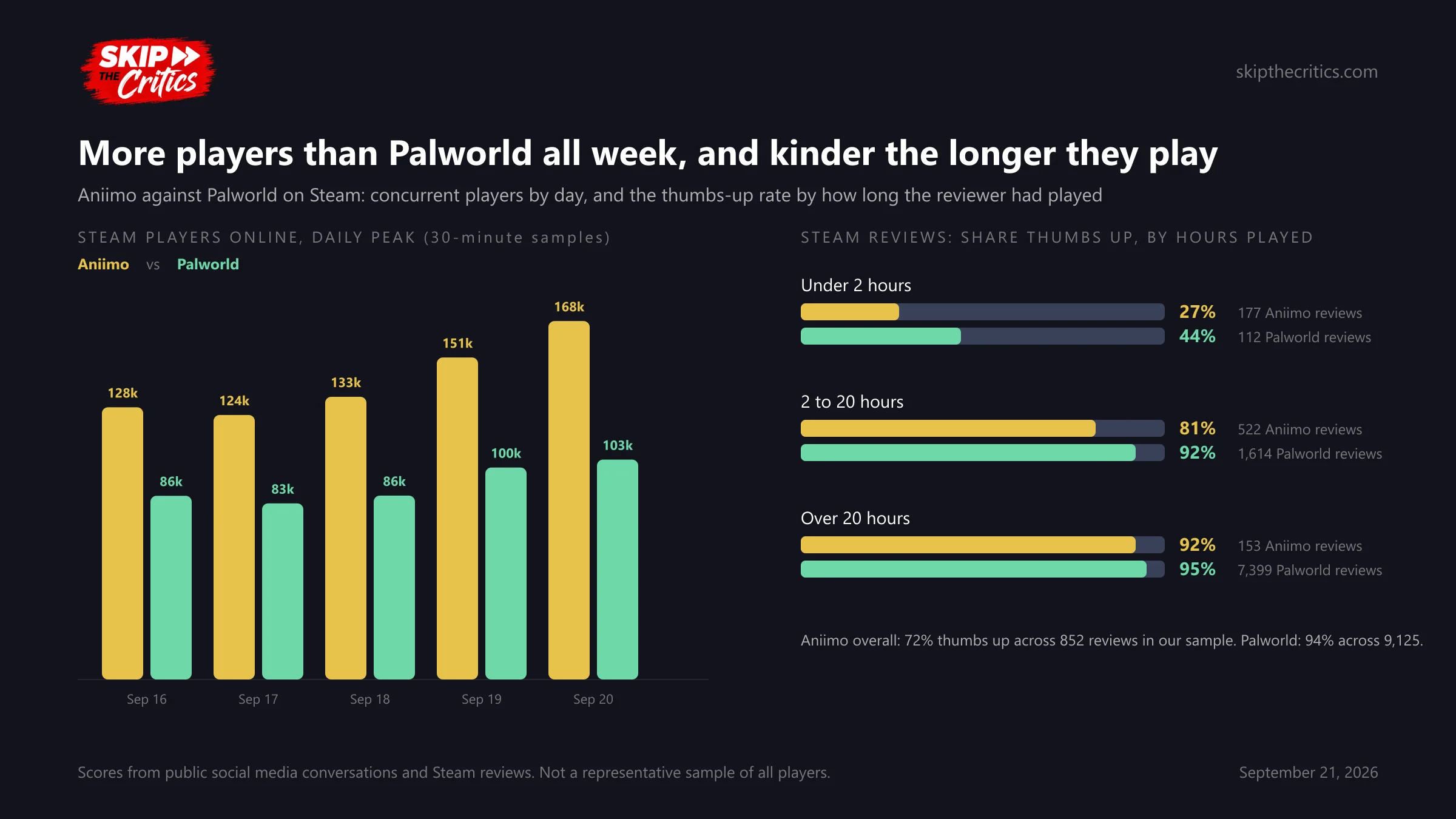
We sample Steam player counts every thirty minutes. Aniimo's daily peak was 127,782 players on launch day, dipped to 124,160 on Thursday, and then rose every day: 132,705, 151,158 and 168,260 on Sunday, its highest so far. Palworld on the same five days peaked between 82,663 and 103,221. Aniimo has had more people online than Palworld every day since it launched. Free games clear that bar more easily than paid ones, and Palworld's own peak since we began tracking it in late August was 204,421, so this is a strong launch rather than a takeover. It is a launch that is growing into its first weekend, which is not the shape most launches have.
The Steam reviews tell the story of the score in one table. Across 852 reviews in our sample, 72% are thumbs up. Among reviewers who had played under two hours, 27% are, from 177 reviews. Between two and twenty hours it is 81% from 522. Over twenty hours it is 92% from 153. Palworld has the same slope from a higher floor: 44% under two hours, 92% between two and twenty, 95% over twenty, and 94% overall across 9,125. Aniimo's negativity is front-loaded in people who bounced, and the crashes and the first impression of the monetisation are the likeliest reasons. The people who stayed rate it almost exactly as Palworld's long-haul players rate theirs.
The reviews also split by language in a way the score cannot see. English-language reviews, 1,080 of them, run 74% thumbs up. Brazilian Portuguese, 213, run 87%. Simplified Chinese, 122, run 24%, and half of those reviewers had played under two hours. Korean, 76, run 55%. Something about the launch landed differently for Chinese-language players, and the under-two-hours share says it landed early, at install or first session, rather than after a week of play.
Streaming followed the usual launch curve, only steeper. Across the top 500 live channels, Aniimo peaked at 70,605 viewers on launch day, 66,413 the day after, then 42,584, 35,251 and 32,201: down 54% in five days while the number of people playing went up 32%. Palworld draws two to three thousand viewers a day at this point in its life. The people watching Aniimo are becoming people playing it, which is the trade a free game wants.
What to watch
Three numbers will decide whether the 77 holds. The first is the positive share among people who have played it, which has risen every day from 63% on launch day to 76% in the latest partial day; if the launch crowd thins and that share holds in the mid seventies, the score drifts up toward 80. The second is performance, which is the only aspect that got worse after release and the one a patch can move. The third is value, which is unusually kind for a free game right now, in the first week, before the battle pass has cycled once; the 66 is the read of people who have not yet been asked to pay twice.
The multiplayer number is the one to hold loosely. It is a 57 on 194 mentions, a fraction of the gameplay sample, and it is the aspect where Aniimo is furthest from the game it keeps being compared to. If Aniimo's crowd starts talking about playing together the way Palworld's does, the comparison will get fairer and the score will tell us which way.
Aniimo's score updates every night as new reactions come in. The live number, the trend, and the full breakdown: See Aniimo's live Real Score
Palworld's current score, aspects and Steam numbers, for the other side of the comparison: See Palworld's live Real Score
Method notes. Our numbers are an analysis of public online conversation and Steam reviews, not a survey of all players, and the sample is people who chose to say something about the game in public. Steam player counts are our own thirty-minute samples and daily peaks are the highest sample in a UTC day. Twitch viewers are summed over the top 500 live channels at each sample. The hype read and the audience score come from the same engine with the same rules; the only difference is that one was locked on launch day and the other keeps moving. Palworld's figures are its standing today, not its launch week.